Warning Signs
5 Signs a Tree Needs to Come Down
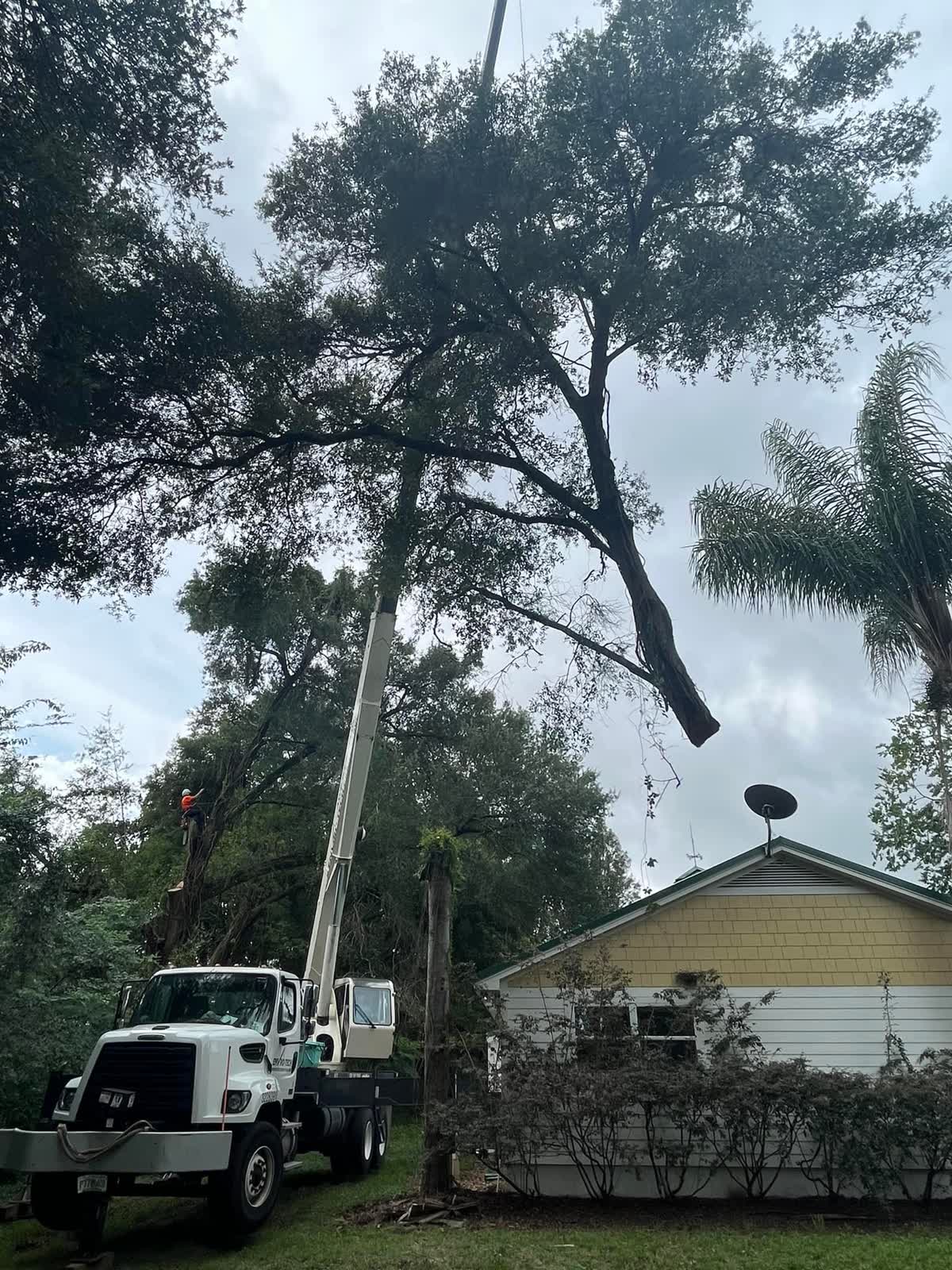
Before we get into the list, here's the thing we tell almost every homeowner who calls us worried about a tree: our default position is to save it. Most trees that look concerning to an untrained eye are actually fine with the right trim, and removal is genuinely the last call we make, not the first one we suggest. That said, some trees really do need to come down, and knowing the real warning signs—versus the things that just look scary but aren't—can save you a lot of worry.
1. A lean that's changed recently
Plenty of trees have grown with a natural lean their whole lives and are perfectly stable — that's just how they grew, reaching for light. What worries us is a lean that's new or getting more pronounced, especially paired with lifted or cracked soil on the opposite side of the trunk. That combination usually means the root system is starting to fail, and a tree can go from "leaning" to "on the ground" faster than people expect once that starts.
2. Mushrooms, conks, or soft spots at the base
Fungal growth at the base of the trunk or along major roots is one of the clearer signs of internal decay — it's a sign the fungus is already breaking down wood, and that decay is very often more extensive underground than what you can see above it. A trunk that feels soft or gives when pressed near the base is another version of the same problem. Neither one means automatic removal, but it does mean the tree needs a real look, not a guess.
3. Major deadwood hanging over a target
A few dead twigs in the canopy are normal and not urgent. Large dead limbs positioned over the roof, driveway, a play area, or anywhere people regularly walk or park are a different story — dead wood doesn't give any warning before it lets go, and there's no predicting exactly when. In a lot of cases the tree itself is otherwise healthy and just needs the deadwood removed, which is a trimming job, not a removal.
4. Cracks or cavities in the trunk or major limbs
A vertical crack running down the trunk, or a hollow cavity you can see or reach into, both point to compromised structural integrity at exactly the point that's supposed to be holding the tree together. Small cavities in an otherwise healthy tree aren't automatically a death sentence — plenty of mature oaks carry some hollowing and are still structurally sound — but a crack that's clearly opening up, or a cavity that takes up a large share of the trunk's cross-section, is worth having assessed in person.
5. A pattern of big limbs coming down on their own
One large limb failure can be a fluke — storm damage, a weak union, bad luck. A pattern of repeated major limb drops from the same tree, especially without an obvious external cause like a specific storm, usually points to a deeper problem with the tree's overall health or structure that a single trim isn't going to fix. That's a tree we'd want to evaluate as a whole, not limb by limb.
The honest counterpoint
None of these signs are an automatic removal on their own. We've walked plenty of properties where a homeowner was sure a tree needed to come down and it just needed a structural trim — deadwood cleared, weight relieved, a hazard limb removed — and the tree was fine to keep. Removal is what we recommend when the risk genuinely outweighs what can be fixed with pruning, not as a default answer. If you're seeing one or more of these signs, the best next step is having someone actually look at the tree in person rather than guessing from the ground.
Heading into storm season?
A lot of these same warning signs are exactly what we check for on a pre-season storm-readiness walkthrough.
Not sure which of these applies to you?
Free, no-pressure quote. We'll walk the tree with you and give you a straight answer—trim it or take it down.