Prevention
Defensible Space: A Firewise Clearing Guide for Central Florida Homes
"Defensible space" is a wildfire term, and if you're picturing dry California hillsides, that's fair — that's where the phrase comes from. But the idea behind it isn't exclusive to wildfire country, and it applies more to a lot of Central Florida properties than people realize. It just shows up here wearing a different hat: overgrown lots backing up to woods, thick palmetto that hasn't been touched in years, a dead pine or two nobody's gotten around to, and canopy that's grown right up against the roofline. Whether the risk on your mind is fire or the next named storm, the fix looks almost identical — open up the space around your house so nothing close by can hurt it.
Florida's version of the same problem
We don't get the headline wildfires that some western states do, but Florida has its own dry stretch — the months before summer's afternoon storms roll in and green everything back up — and a lot of the lots we work on around Weirsdale, The Villages, Ocala, and Leesburg are sitting on real fuel without anyone thinking of it that way. Saw palmetto thickets that have been left to build up for years burn hot once they're dry. A stand of pines dropping needles into an unraked bed of duff does the same thing. Dead or dying pines — and we see plenty, usually from lightning strikes, beetles, or just old age — are standing fuel until they come down on their own or someone deals with them first.
Then there's the piece that ties straight back to what we usually talk about on this blog: canopy touching the roofline. It's a problem for the exact same reason in both directions. In a fire scenario, it's a bridge — embers or flame can travel from brush into a canopy that's already resting on your shingles. In a storm, it's the limb that scrapes the roof loose or comes down on it outright. Either way, the fix is the same: get air between the tree and the house.
The zones, adapted honestly for a Florida lot
The Firewise concept most homeowners run into is built around three rings measured out from the structure. It was written with bigger, more rural lots in mind, but the logic scales down fine — here's what it actually means on a property our size:
Zone 0 (0–5 feet): the ring right against the house. This is the one that matters most and costs the least to fix. Nothing here should be able to carry an ember or a flame into the structure — no dry mulch piled against siding, no dead leaves packed in a corner by the AC unit, no firewood stacked against the wall, gutters kept clear instead of holding a summer's worth of oak leaves and pine straw.
Zone 1 (5–30 feet): the "lean, clean, and green" zone. Lawn and landscaping here should be maintained, not overgrown — shrubs spaced apart rather than growing into one solid wall, low limbs that let a ground fire climb into a canopy removed, dead material raked up instead of left to build up season after season.
Zone 2 (30–100 feet): the thinning zone. On a rural or wooded acreage this is real distance to work with; on a standard subdivision lot it might just be the strip between your back fence and the tree line. Either way, the goal is the same at whatever scale you've got — break up continuous, unbroken brush and canopy so there's nothing that lets a problem travel unchecked from the property line to your back door.
What you can knock out yourself
A lot of Zone 0 and Zone 1 work is genuinely homeowner-sized. Raking pine straw and leaf litter away from the foundation, clearing gutters, trimming low limbs you can reach safely, hauling off small brush piles, keeping the lawn mowed close to the house, and thinning out ornamental shrubs that have grown into each other are all things you can chip away at on a weekend without needing anyone's help.
When it's time to call in equipment
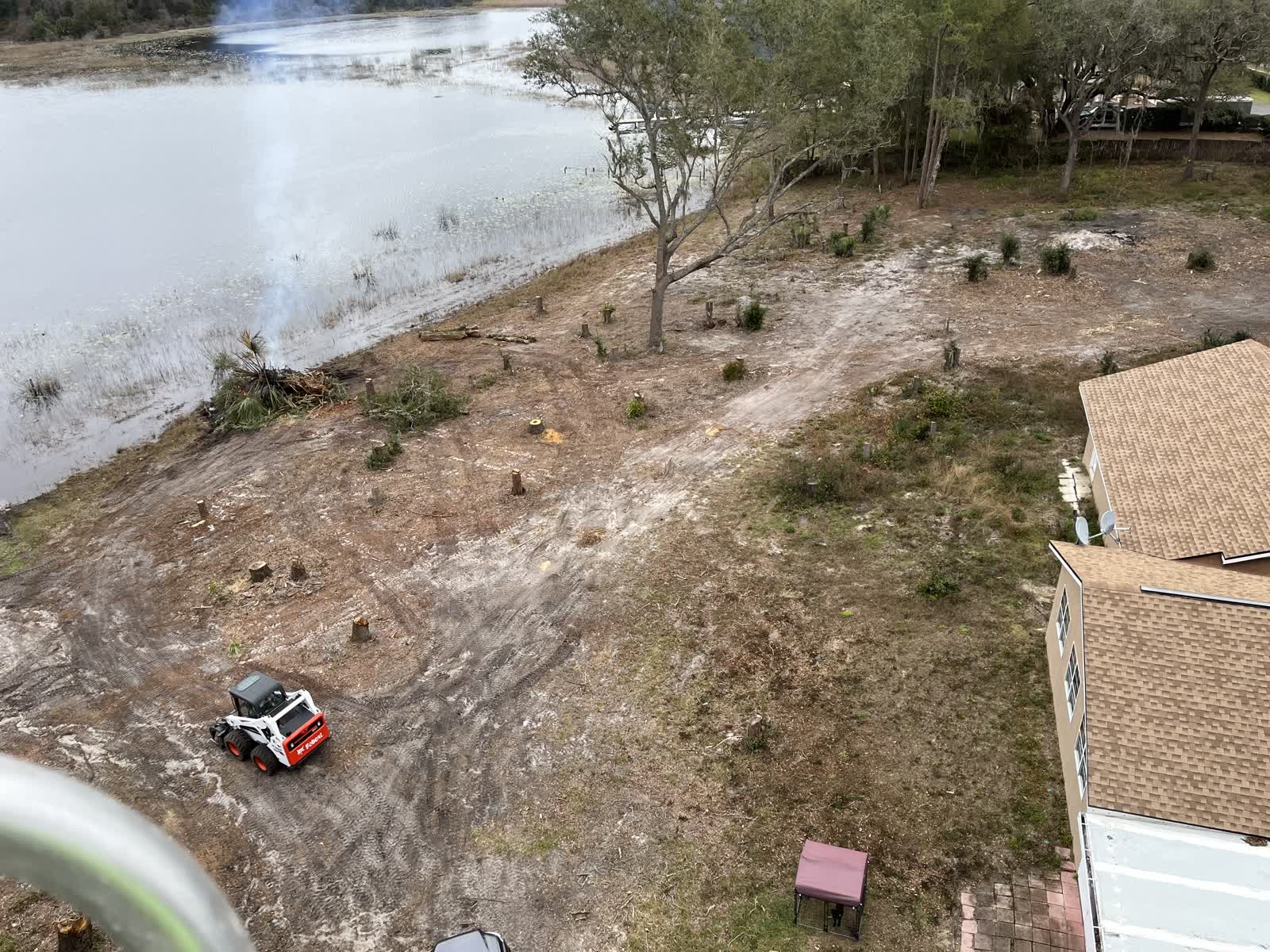
Where it stops being a weekend project is dense saw palmetto that's built up over years, a leaning or dead pine anywhere near the house, heavy limb overhang across a whole roofline, or a wooded lot edge that needs real thinning rather than a trim. That's mechanical work — grapple, mulcher, loader — not loppers and a wheelbarrow, and it's the kind of job worth being careful with, since a felled tree or a misjudged limb near a structure is not the place to learn on the job. We're owner-led and family-owned, and we own our own equipment rather than subbing it out, so when a property needs that heavier pass, it's the same crew handling it start to finish. That's the same work we do under land clearing for a wooded lot or a full property that's gotten away from someone.
This is also hurricane prep
Almost everything above — dead pines, canopy over the roof, overgrown brush — is exactly what we tell people to check before hurricane season, too. One pass off the property handles both risks at once.
Where this overlaps with storm season
If you've read our hurricane prep guide, a lot of this is going to sound familiar, and that's not an accident. A dead pine is a hazard whether the threat is a spark or 60-mph gusts. Canopy resting on the roof is a liability year-round, not just June through November. Doing a defensible-space pass on your property before Florida's dry months and doing your pre-hurricane-season check are, in practice, close to the same walk around your yard — which means it's worth doing once, thoroughly, rather than twice. If a storm's already come through and left debris or damage behind, that's a different job — see our storm cleanup page for that.
Programs worth knowing about
We're not affiliated with either of these, certified by them, or speaking for them — but they're real, and worth a homeowner's own research. The Florida Forest Service tracks wildfire risk and burn conditions statewide and publishes homeowner guidance directly. Firewise USA, a national program run through the NFPA, has a more detailed breakdown of the zone system if you want to go deeper than what's above. Both are good, independent places to check current conditions or dig further into the specifics for your own property.
None of this requires panic or a total yard overhaul in one weekend. Most properties get the biggest benefit from the smallest, closest ring first — clear what's right against the house, then work your way out as time and equipment allow. If you get to a point where the job needs equipment instead of a rake, that's exactly what we're here for.
Not sure what your property actually needs?
Free, no-pressure quote. Ryan walks every property himself and will tell you honestly what's DIY-sized and what isn't.